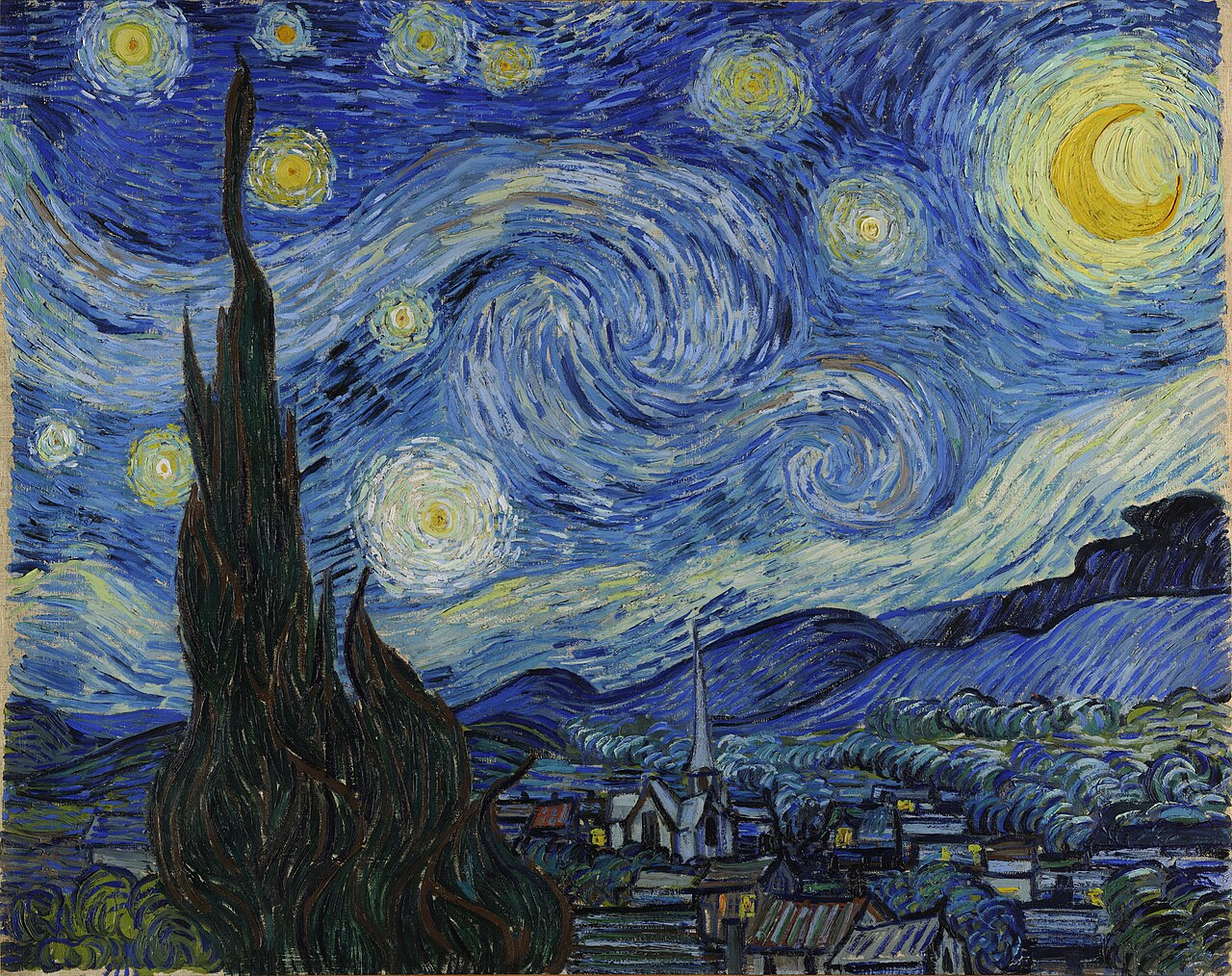
Starry Night, 1889 · Museum of Modern Art, New York
Starry Night
Context
Painted during Van Gogh's voluntary stay at the Saint-Paul-de-Mausole asylum in Saint-Rémy-de-Provence, The Starry Night depicts the view from his east-facing window just before sunrise — with the addition of an idealized village. The swirling, luminous sky reflects the artist's turbulent emotional state, yet also his profound sense of wonder. Van Gogh described the painting in a letter to his brother Theo as 'a study of the night.'
Discussion 4 comments
The way Van Gogh captures movement in the sky — those swirling brushstrokes feel alive. You can almost feel the wind.
I didn't realize he painted this from memory and imagination, not from direct observation of the night sky. That changes everything about how I see it.
The cypress tree in the foreground pointing up like a flame toward the stars — it's such a powerful vertical contrast to all that horizontal swirling energy.
Knowing he painted this while in an asylum makes it feel both more tragic and more miraculous. Art as survival.

Girl with a Pearl Earring, 1665 · Mauritshuis, The Hague
Girl with a Pearl Earring
Context
Often called the 'Mona Lisa of the North,' Vermeer's masterpiece is technically a tronie — a Dutch term for a character study rather than a formal portrait. The identity of the girl has never been confirmed. The luminous pearl earring and the way the subject looks over her shoulder create an intimate, fleeting moment of connection that has captivated viewers for over 350 years. Vermeer's use of light against the dark background remains a hallmark of his genius.
Discussion 3 comments
The mystery of who she is makes this more compelling than any documented portrait. We project ourselves onto her gaze.
Vermeer's light here is extraordinary — see how it wraps around her face? You feel warmth from a 350-year-old canvas.
The moment of turning — she's caught mid-thought. It's one of the most psychologically loaded poses in all of Western art.

The Persistence of Memory, 1931 · Museum of Modern Art, New York
The Persistence of Memory
Context
One of the most recognizable works of Surrealism, this small painting depicts melting pocket watches draped across a barren Catalan landscape — the cliffs of Cap de Creus near Dalí's home. Dalí described the concept as inspired by a meditation on Camembert cheese melting in the sun. The limp watches suggest that time is not a fixed, rigid force but malleable — an idea resonant with Einstein's theory of relativity and the dreamlike logic of the subconscious mind.
Discussion 3 comments
It's easy to dismiss Dalí as 'weird.' But this painting has a genuine visual logic — every element earns its place.
The melting watches are about subjective time — how an hour of joy feels different from an hour of waiting. Dalí just made it literal.
23 x 33 centimeters. The most famous small painting in the world. The scale makes seeing it in person so surprising.